Updated November 2026. We rewrote this guide as a side-by-side comparison of fiberglass, steel and wood front doors for Connecticut weather, with current ENERGY STAR criteria.
For most Connecticut homes, a fiberglass front door holds up best overall: it does not rust, rot or warp, insulates well and handles our freeze-thaw winters and humid summers with little maintenance. Steel is a strong, secure choice when the door is protected from dents and its finish is kept intact. Wood gives the most authentic look for Colonials and historic homes, but it needs a covered entry and regular refinishing to last.
Below we compare all three on what actually wears out a front door in Connecticut, so you can choose with confidence. For styles and options, see our exterior doors page.
Quick comparison: fiberglass vs steel vs wood
| What matters in Connecticut | Fiberglass | Steel | Wood |
|---|---|---|---|
| Freeze-thaw and temperature swings | Very stable, does not warp | Stable; the insulated core does the work | Can swell, shrink and warp without protection |
| Rain, snow and humidity | Will not rot or swell | Can rust where the coating is scratched | Needs a good finish and ideally an overhang |
| Salt air near the shoreline | Good choice | Watch for corrosion at chips and edges | Finish wears faster |
| Dents and impacts | Resists dents | Can dent; dents are hard to repair | Can scratch or gouge, but can be repaired |
| Maintenance | Low | Low, touch up scratches quickly | Highest: periodic refinishing |
| Insulation | Excellent with a foam core | Excellent with a foam core | Lower unless it has an insulated core |
| Look | Smooth or realistic wood-grain | Smooth, paintable | Real wood grain and character |
| Best for | Most homes, any exposure | Security, covered or sheltered entries | Historic homes, covered entries |
The table compares typical modern doors. Quality varies by brand and product line, so ask to see the specifications of the exact door you are considering.
Fiberglass front doors

How it holds up: Fiberglass is the most forgiving material for Connecticut’s climate. It does not rust like steel or rot like wood, and it stays stable through cold snaps, thaws and humid summers. A foam core gives it strong insulation, and it resists the everyday dents that steel doors pick up.
Things to know: Wood-grain fiberglass can be stained to look like oak, mahogany or cherry, which makes it a popular alternative to real wood. Quality matters: better doors have deeper, more realistic grain and stronger frames.
Best for: almost any Connecticut home, including entries that face weather head-on with no porch roof. Learn more in our guide to fiberglass doors in Connecticut and on our Therma-Tru doors page.
Steel front doors
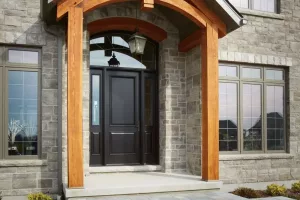
How it holds up: A steel door with an insulated core is strong, secure and energy efficient. Its weak points are its skin and finish: a dent from a hard hit is difficult to fix, and where the coating is chipped or scratched, steel can start to rust. In Connecticut that matters most on exposed entries and near the shoreline, where road salt and salt air speed up corrosion.
Things to know: Keep the finish in good shape and touch up scratches quickly. A covered entry helps a steel door last.
Best for: homeowners who want strength and security, especially on side and garage entries or sheltered front doors. See our guide to steel entry doors in Connecticut.
Wood front doors

How it holds up: Wood is a natural material, so it reacts to moisture and temperature. Without a good finish and some shelter, it can swell in humid weather, shrink in dry winter air, crack or warp. Sun and rain also break down the finish over time.
Things to know: A wood door can last for decades when it sits under a porch roof or deep overhang and is refinished on schedule. Modern wood doors with an engineered or insulated core are more stable than solid slab doors. If your home is in a local historic district, check with your town before changing the look of your entry.
Best for: historic and high-end homes with a covered entry, where the real wood look matters most. Read more in our guide to wood entry doors in Connecticut and see Marvin doors and JELD-WEN doors.
What matters as much as the material
Energy efficiency: check the ENERGY STAR label
ENERGY STAR rates doors by how much glass they have. According to the ENERGY STAR criteria for residential doors, a certified door in Connecticut’s Northern climate zone must meet:
| Door glass | U-factor (lower is better) | SHGC |
|---|---|---|
| Opaque (no glass) | 0.17 or less | No rating |
| Up to half glass | 0.23 or less | 0.23 or less |
| More than half glass | 0.26 or less | 0.40 or less |
The less glass a door has, the better it insulates. If you want lots of light, sidelights and a transom with insulated glass are a good compromise. Read more in our guide to energy-efficient doors.
Note that the federal tax credit for energy-efficient exterior doors ended for doors installed after December 31, 2025, according to the IRS.
Installation and weatherproofing
Even the best door leaks air and water if it is installed poorly. A long-lasting front door in Connecticut needs a square, plumb frame, a properly flashed and sealed sill, tight weatherstripping and an insulated threshold. That is why professional installation matters as much as the material. See 7 benefits of hiring a professional for door installation and our installation process.
Your entry’s exposure
A door that faces south or west, or has no porch roof, takes the most sun, rain and snow. That is where fiberglass shines. A deep, covered porch gives you more freedom to choose wood or steel.
Which front door is right for your Connecticut home?
- Exposed entry, low maintenance wanted: fiberglass.
- Security first, sheltered entry: steel.
- Historic Colonial or Victorian with a covered porch: wood, or wood-grain fiberglass if you want the look without the upkeep.
- Lots of natural light: fiberglass or steel with ENERGY STAR glass panels, sidelights or a transom.
We install entry doors from Therma-Tru, Marvin, JELD-WEN, Andersen and ProVia, so we can match the right material and style to your home. For the full guide to choosing and installing a new door, read entry door installation and replacement in Connecticut.
Frequently asked questions
Which front door material lasts the longest in Connecticut?
For most homes, fiberglass, because it does not rust, rot or warp and needs little maintenance. A well-maintained wood door under a covered porch can also last for decades.
Is fiberglass better than steel for a front door?
Fiberglass is usually the better all-round choice in Connecticut because it resists dents and cannot rust. Steel is a strong, secure option for sheltered entries when the finish is kept intact.
Do steel doors rust in Connecticut?
The steel itself is protected by its coating. Rust starts where the coating is scratched or chipped, so touch up damage quickly, especially near the shoreline or where road salt reaches the entry.
Is a wood front door a bad idea in Connecticut?
Not if it is protected. A wood door works well under a porch roof or deep overhang and with regular refinishing. On an exposed entry, wood-grain fiberglass is the lower-maintenance alternative.
Which front door is most energy efficient?
Fiberglass and steel doors with foam cores insulate best. Look for the ENERGY STAR label and choose less glass for the most efficient door.
Find the right front door with Superior Windowland
Superior Windowland is a licensed and insured Connecticut contractor (HIC.0639277), BBB Accredited since 2014, with our own installation crews. We replace entry doors for homeowners in Newtown, Danbury, Fairfield, Norwalk and Southbury.
Compare fiberglass, steel and wood doors in person at our showroom at 3 Simm Lane in Newtown, or book a free, no-pressure in-home estimate: call (203) 479-9703 or contact us online. Browse all our exterior door options and financing options.